Now Hiring: Program Assistant

Position Opening: Program Assistant 
Classification: Part-Time (25 hours/week), Temporary
Location: Boston area, primarily work from home with occasional travel
Posted: August 2021

JOIN for Justice, the Jewish Organizing Institute and Network, is building a powerful field of Jewish leaders capable of effectively organizing for justice, both inside and outside Jewish communities in the US. We organize because, in the words of Emma Lazarus, “Until we are all free, we are none of us free”—our destinies are bound up as one. We train and mentor rabbis, community leaders and community organizers through a variety of intensive organizing training programs, in person and online.

This part-time position will be 25 hours/ week until early May 2022.  The primary task of the position is to provide critical support to our programs team, across multiple training programs. Currently our programs have all moved online but some will be returning to in-person events in Boston and elsewhere in January 2022.  The ideal candidate is very detail oriented, completing many important administrative and technical tasks to ensure our programs’ success.  

Primary responsibilities include:

  • Manage the registrations process for multiple programs. Includes tracking fees & scholarships, answering participant inquiries and doing database entry. Produce reports on registration status as needed. 
  • Responsible for coordinating and scheduling meetings between staff, participants and consultants (trainers/facilitators). 
  • Responsible for arranging for services to assist with participants’ access needs, including arranging for American Sign Language interpreters, closed captioning or other disability accommodations as required. Prepare transcripts from closed-captioned Zoom events. 
  • Learn our online course software program, help set up sections, update records, assist with troubleshooting participant tech questions.
  • Zoom event technical support: Support trainers and facilitators by hosting Zoom meetings with multiple breakout rooms & screen shares. Also recruit, schedule, train & oversee other Zoom meeting technical support as needed. 
  • Provide in person administrative and logistical support for weekly sessions of the Jewish Organizing Fellowship in Boston.
  • Manage in-person event and retreat logistics: schedule meetings, book meeting space, coordinate with trainers, make travel arrangements, plan & arrange for meals (accommodating an array of complex dietary restrictions), prepare needed printed training materials.  NOTE – US Travel Required – attend each retreat as support staff. (Estimated 4 days away from home for each retreat. Estimated two retreats during tenure, one in Greater Boston, one in Greater Baltimore).
  • Pick up and process organizational mail.
  • Administrative tasks to support the back end of programs, such as designing training handouts, entering updates for course materials on our learning platform and sending evaluation surveys.
  • If the program assistant is interested, there may be opportunities to expand their work to be more involved with organizing programming.

Skills needed:

  • Ability to track multiple projects with multiple needs at the same time.
  • Be accountable to colleagues for completing tasks and meeting deadlines.
  • General customer service skills for supporting program participants and responding to their questions. 
  • Comfort with computer software and learning new systems, like our specialized online training program and database system. Expected technical skills include Microsoft Office or Google docs, plus Gmail and Zoom meeting hosting experience.
  • Event planning/running experience (either paid or volunteer).
  • Familiarity with community organizing is a plus.

The pay range for this position is $21 – 24/ hour for 25 hours/week. It has full access to all employee benefits, including health insurance, at a part-time employee-paid rate.  This temporary position is expected to expire in April.

Work Location:
This position will be primarily work from home, with commuting into Boston as needed to pick up the mail and for in-person event support and meetings.  JOIN currently has no physical office space, though it is exploring the possibility by the end of the year.  If we do reopen a physical office, the person holding this position may be asked to spend some time there. 

How to Apply:
A cover letter is required.  In your cover letter, please explain your interest in this position and JOIN’s social justice work.  Because one important part of the job will be assisting with people’s access needs so that they can fully participate in our training, please share any experience with supporting people’s access needs.

Please send your cover letter & resume to jobs@joinforjustice.org.

JOIN for Justice is an equal opportunity employer. We carefully consider applicants for all positions without regard to race, color, religion, creed, gender identity, sexual orientation, national origin, age, disability, marital or veteran status, or any other legally protected status.

Posted in Fellowship, General | Comments Off on Now Hiring: Program Assistant

Now Hiring: Jews of Color Organizing Fellowship Director and Trainer

Position Opening: Jews of Color Organizing Fellowship Director and Trainer
Classification: Full-Time, Exempt
Location: Work from Home with occasional travel
Posted: September 2021

JOIN for Justice is building a powerful field of Jewish leaders capable of effectively organizing for justice, both inside and outside Jewish communities in the US. We organize because, in the words of Emma Lazarus, “Until we are all free, we are none of us free”—our destinies are bound up as one. We train and mentor rabbis, community leaders and community organizers through a variety of intensive organizing training programs, in person and online. 

Jews of Color Organizing Fellowship Program (JOCOF):
We are preparing to launch a national cohort-based leadership development program for Jews of Color – one that provides training, mentorship and community support to help participants grow as powerful community organizers and social movement leaders. The pilot program will train 18 Jewish Leaders of Color across four cities, which may include Chicago, the Bay Area, Atlanta, Baltimore, and NYC. The Director will be a guide and mentor to the program participants and support a quickly growing field of BIPOC Jewish organizers who are stepping into their power, taking on tough campaigns, and challenging and transforming both our justice movements and our Jewish communities. 

Position Overview: 
The program director will play a central role in guiding and shaping this new program including: completing the curriculum design; establishing selection criteria and selecting program participants; guiding program participant matches with organizing placements; leading the training and building 1:1 relationships with the program participants; recruiting and managing a team of supporting trainers and coaches; and, building and sustaining relationships with partner organizations and a team of program advisors. 

The ideal candidate has a solid background in community organizing for social change – meaningful professional and/or volunteer experience directly organizing in the field, doing work such as running campaigns, helping build coalitions, developing leaders – and is looking for a leadership position responsible for designing and launching programs and supporting other people’s development.  This person will be part of a team of Program Directors at JOIN who each run a program, share resources and knowledge, and occasionally collaborate on special projects. This person will report directly to the Director of Programs and work closely with a JOCOF Advisory Committee, and will have access to professional development funds to support their leadership. 

Responsibilities:

  • Represent JOIN and establish JOIN’s presence in four cities, including meaningful relationships with local social justice leaders, Jewish community organizations, funders, and potential partner organizations.
  • Tapping into JOIN’s extensive library of training modules, curriculum plans, and networks, develop and manage the program’s curriculum: design learning goals, develop a series of trainings to move people towards those goals, and recruit outside trainers & educators as part of the training team. Training settings include virtual trainings, in-person meet-ups, and retreats.
  • Utilize advanced facilitation skills & understanding of group dynamics for running retreats, and facilitating training events.
  • Be a strong 1:1 mentor, able to support participants across lines of difference (including race, gender, ability status, and class) but also able to challenge and push them to grow.
  • In coordination with our recruitment and communications staffer, oversee outreach and recruitment for fellows as well as recruiting organizations to employ one of our fellows in each of four locales. Work to match fellows with placement organizations. Provide support over the course of the fellowship to both fellow & employer.  
  • Work with an external evaluator. Undertake periodic internal evaluations to improve the program over time. Analyze results and make recommendations for future changes. 
  • Effectively manage the program budget. 
  • Recruit and engage the JOCOF Advisory Committee to guide the program’s strategic choices and provide ongoing accountability to the larger JOC community and other important stakeholders groups.
  • In coordination with development staff and Executive Director, report out to key stakeholders and strategize about approaches to gain resources for the organization’s work. 
  • Help design and implement trainings for other audiences and paid clients, as part of JOIN’s trainer team.

Qualifications and Desired Experience:

  • Experience launching new programs, ideally national in scope.
  • Strong experience in anti-oppression training and facilitating diverse groups with a range of experiences in a participatory manner. 
  • Deep familiarity and nuanced understanding of the experience and needs of Jews of Color and the impact of racism, and more specifically anti-Black racism, on Jews of color.
  • Significant personal experience (professional and/or volunteer) with community organizing — bringing people together to act collectively toward a common vision.
  • Experience as a trainer.
  • Experience with program design, project management, and evaluation.
  • Ability to develop the leadership of organizers and guide them in the design and implementation of an organizing strategy.
  • Ability to work in a team environment, to delegate, and to support colleagues at all levels of the organization.
  • Versed in Microsoft Office (or Google Docs), GMail, and Zoom. 
  • Some familiarity with Jewish community/culture/religion.
  • Budget management experience preferred.
  • Experience developing partnerships with other justice organizations.

Travel Requirements: 
The program includes three retreats a year, approximately 4 days each.  The director will also travel for local site visits to the four program cities (expected once or twice a year per city) and one JOIN staff retreat a year. The program director has some flexibility in scheduling these travel events.  

Compensation and Benefits

  • Salary Range: $60,000 to $79,000 depending upon experience.
  • Benefits: 80% employer paid health and dental insurance, 5% 401k match after one year. Other benefits include life insurance, disability insurance, health & dependent care FSA accounts. 
  • Vacation time: 12 days in first year, 15 days in second year. 
  • Holidays: Generous holiday schedule, plus Jewish holidays. 
  • WFH Office: A company computer will be provided, plus $50 a month to cover home office expenses. Employee must be residing in the United States.   
  • Union membership: This position is represented by the JOIN Workers Union, a member of NPEU/Local 70, IFPTE.

More about JOIN for Justice
Our current programs include our 18-month Clergy Fellowship, wherein we are training and supporting teams of rabbis in Miami and St. Louis to engage their congregations to build power and get involved in local multi-faith, multi-racial organizing. We also run a new seven-month long national organizing training program for disabled Jewish organizers in their 20s and 30s called Access to Power. Participants get intensive training and individualized coaching as they learn about disability organizing history, the nuts and bolts of running campaigns and how to organize to fight ableism, racism and other forms of oppression.  JOIN for Justice also sponsors the Jewish Organizing Fellowship, a year-long organizing fellowship for young Jewish adults in Boston, as well as training in Jewish seminaries across the country and online courses and trainings.

At JOIN for Justice, we believe social justice requires the voices of those most directly impacted by injustice. JOIN is dedicated to building a culturally diverse and pluralistic staff team — via internal training, structured reflection exercises and an ongoing investment in the leadership development of staff. JOIN strongly encourages people of color, indigenous people, disabled people, LGBTQ+ people, and immigrants to apply. You do not need to be Jewish. 

To apply: Please send a cover letter and resume, as two separate documents in a single email, to JOCOFDirector@joinforjustice.org. 

JOIN for Justice is an equal opportunity employer. We carefully consider applicants for all positions without regard to race, color, religion, creed, gender identity, sexual orientation, national origin, age, disability, marital or veteran status, or any other legally protected status.

Posted in Diversity Equity and Inclusion, Fellowship, General | Comments Off on Now Hiring: Jews of Color Organizing Fellowship Director and Trainer

SEA (Study, Engage, Act) Change

You can learn more about SEA Change here. 


Study * Engage * Act * Change

By Karen Herron

Image Description: image of a blue wave on an orange background. The wave is curing toward the text "SEA CHANGE Study | Engage | Act".

Image Description: A blue wave on an orange background  curing toward the text “SEA CHANGE Study | Engage | Act”.

As individuals and institutions increasingly strive to understand their roles in perpetuating structural racism in the United States, questions abound regarding how to affect meaningful and lasting change. The long-overdue interest spurred a preponderance of virtual events and programming to educate Jewish communities about the history of racism, the experiences of Jews of Color, and an increased awareness of the intersectionality of factors such as race, gender, ability, and socioeconomic position.  Yet, despite new awareness and understanding of the causal factors, the search for solutions to rampant inequity can overwhelm even the most informed and best intentioned among us.

In early 2020, before the pandemic and racially charged atrocities brought to light on social media focused our country’s attention on racism, two large, mainstream congregations in the suburbs of Washington, D.C. initiated efforts to jointly address the persistent inequity in our midst.  Crossing denominational lines, B’nai Israel and Washington Hebrew Congregations, representing the Conservative and Reform movements, both have deep historical roots in Montgomery County, Maryland. 

Recognizing the opportunity to seize this moment to learn with intention, build relationships, and work together toward a more just future, Washington Hebrew and B’nai Israel joined forces to engage in sacred work to address racial inequity and injustice so that our community reflects our values.  

As a first step, a planning committee comprised of clergy and lay leaders participated in a racial equity training implemented by a local community organization.  Next, we undertook an extensive search of local and national organizations to find an experienced partner who could shape and implement a plan to pursue our mission. We retained JOIN for Justice to bring their expertise and experience in building strong Jewish communities capable of effectively organizing for change. While the focus of SEA Change is racial equity, our choice was also motivated by the stories we heard of how other synagogues were transformed through JOIN’s guidance in incorporating the principles of community organizing.

In November, we launched SEA Change Racial Equity Roundtable, a unique cohort of 50 diverse individuals, comprised of 22 congregants and 3 clergy members from each synagogue, to study and engage together in order to act as change agents within our congregations and in Montgomery County.

The congregants who chose to participate in the multiyear initiative recognized that we cannot wait for our leaders to deliver change. Motivation to participate varied from concerns for the larger community to personal yearnings for inclusion in Jewish communal life.  One applicant to the program noted “Indifference to oppression is just as dangerous as active oppression. If we don’t actively fight against oppression, then we support it… We have to fight against the oppression of African Americans.”

Another shared “I think a part of the problem facing many Jews of Color is that it’s hard to deal with the microaggressions and racism that sometimes come with our Jewish organizations or synagogues. It is even harder when you don’t see anyone that looks like you or can relate to your experience.”

While another said, “I’ve determined that as a privileged, White American, I want to help turn back systemic racism. As a Jew, I feel I must do more than want… I need to take some action.”

SEA Change is intended to lay the groundwork for us to take action: to identify and address issues of diversity and equity within our own congregations and to work side by side with communities of color to address racial inequity in Montgomery County.  

Both Washington Hebrew and B’nai Israel Congregations have robust social action programming centered around service and ample volunteers willing to lend their time and energy to helping others. However, we recognize that in addition to the valuable service projects that our synagogues regularly undertake, we must also address the underlying causes of poverty and work toward being part of changing the structural foundations that cause unjust situations to continue. 

Just like the chambers of government merely miles from Washington Hebrew’s D.C. campus, both communities include congregants who vote Republican as well as Democratic. In these polarized times, additional goals of our work include serving as a model for creating constructive dialogue among Jews around this topic and relationship building between Reform and Conservative communities.

Along the way, JOIN has tailored the curriculum to our community and been flexible when it seemed best to pivot direction or rethink the order of trainings. Rabbi M. Bruce Lustig, Senior Rabbi of Washington Hebrew Congregation, noted recently that “In a world with so many unknowns, JOIN has been phenomenally flexible at readjusting and adding critical components.  They are organizationally smart and have provided the right platform to think through next steps and also to model to our congregants how to be proactive and responsive at a time when both are increasingly necessary.”

In Phase One of SEA Change, the emphasis was on learning the key principles of anti-racism theory and practice as well as the fundamentals of community organizing. We began with intensive learning about power, race and organizing, exploring the history and the stories we have each inherited and still hold about race, racism, Jewish identity and antisemitism.  

We learned specifically about the historical and present-day reality of race and racism in Montgomery County through the experiences and stories of local leaders of color who are engaged in organizing work in our community. We also heard about the experiences of other congregations who trained with JOIN and successfully integrated community organizing into their communal landscape. Rabbi Lydia Medwin of the Temple in Atlanta and Rabbi Aaron Alexander of Adas Israel Congregation in D.C. imparted valuable knowledge gleaned from their congregational experiences. They generously shared their time and imparted tangible examples that provided a view of how community organizing seeped into different facets of their congregations, allowing us to imagine the impact of integrating a community organizing lens.  Rabbi Lustig shared that “although it is challenging not knowing where the road is going to take us, there is excitement around the possibility.  Those involved have developed wonderful relationships and changed their attitudes and way of thinking.  We are building future congregational leadership from within.”

We are currently in Phase Two of our journey which has us working in teams to investigate a variety of avenues for social change. Following interactive JOIN trainings on conducting internal race equity audits of our own congregations and researching to identify external partners for action in our local community, our dedicated teams are busy putting what they have learned to work. In addition, we are tapping the skills we gleaned in a training on conducting relational meetings through informative and engaging one on one meetings across the cohort.

This is the start of a process that we hope will bear fruit for many years to come and  there have already been lessons learned along the way. Yes, it would have been nice to meet in person to develop personal relationships to help energize the work. But the combination of our country awakening to an awareness of racial inequity and the limitations imposed by the pandemic created an atmosphere ripe for our cohort to convene virtually with JOIN’s talented trainers from across the country. We are making the most of the technological resources we have at our disposal and are looking forward to meeting in person when we are able.

Soon we will cull and evaluate the information gathered from the External Research Team meetings in order to select a campaign or organization with whom we will partner to address racial inequity in our community. The Internal Audit Committees will share the areas they have identified as race equity challenges and opportunities for internal institutional transformation.  This interpretation and selection process will be the focus of Phase Three, and as we move into Phase Four our attention will turn to base building. We will proactively work to integrate what we have learned into congregation activities and recruit additional congregants to be involved through a house meeting campaign.

Rabbi Mickey Safra, Senior Rabbi of B’nai Israel Congregation noted that “SEA Change themes are already starting to permeate throughout different areas of the congregation. I am very appreciative of the guidance and support JOIN has provided and look forward to transitioning to taking off the training wheels and getting to work.” Associate Rabbi Mitch Berkowitz added that “It’s been popping up in organic ways” as he meets with B’nai Israel Committee Chairs to plan for Fall programming. “We now have an opportunity to demonstrate to our community that the investment in SEA Change is broader than the 50 people who have participated so far.”

The success of SEA Change will be measured not only by how many people are engaged in community organizing efforts but also by the type of cultural shifts that are achieved. Already, the relationships developed between the two congregations represent a strong foundation for ongoing sustainable action to achieve change in our community. Rabbi Susan Shankman of Washington Hebrew noted recently, “As relational conversations started, the level of participation is quite high. People are finding partnership in conversation. Cohort members are stepping up and taking ownership through leadership. We have seen intergenerational relationships as well as connections between B’nai Israel and Washington Hebrew members invested in building community.”


Many thanks to Master trainers, Megan Black, and Megan Madison (also a JOIN board member), whose wisdom and talent in developing and  implementing the trainings were invaluable.


Posted in Diversity Equity and Inclusion, Fly on the Wall, From the Field, Success Stories | Comments Off on SEA (Study, Engage, Act) Change

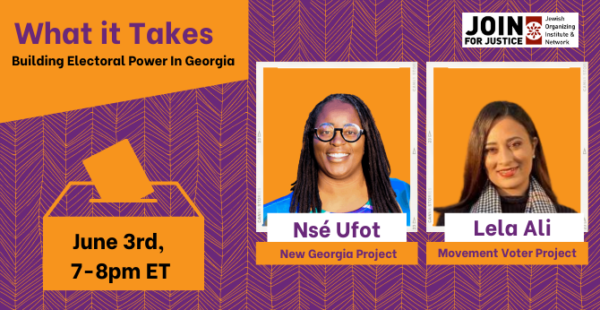
What it Takes: Building Electoral Power in Georgia

Register to join us for this session on June 3 at 7pm ET / 4pm PM.

Captioning will be provided. Please reach out to RB at rbrown@joinforjustice.org for other access needs.

Image Description: “What it Takes Building Electoral Power in Georgia” sits in the top left corner above an image of a ballot going into a ballot box with the date “June 3rd 7-8pm ET” on it. To the right are photos of Nsé Ufot and Lela Ali. Under the photo of Nsé Ufot is her name and “New Georgia Project” under Lela Ali is her name and “Movement Voter Project”. The JOIN for Justice logo sits in the top right corner. 

Georgia’s massive increase in voting and its shift from Republican stronghold in 2000 to a tossup heading into election day this past November was the result of over a decade of strategic, powerful, and creative community organizing across the state, particularly with communities of color and young people. Even then, as a testing ground for restrictive voting legislation and after a primary election rife with problems, flipping Georgia blue was by no means guaranteed. Now, as Georgia has taken the lead of a national movement for voter suppression, organizers will have to adapt yet again. Join us to hear two perspectives on the details of building local progressive power: from Nsé Ufot, Chief Executive Officer of the New Georgia Project, and Lela Ali, State Partnerships Associate with Movement Voter Project. Ufot and Ali will take us through the nuts and bolts of their work to build power one voter – and one donor – at a time.

Captioning will be provided. This call will be recorded and you are welcome to join with video on or off. You may send any questions to RB Brown at rbrown@joinforjustice.org.

Posted in General | Comments Off on What it Takes: Building Electoral Power in Georgia

Leadership Transition Announcement

Why I’m So Excited About JOIN for Justice’s Future
By Phil Rosenblatt, Board Chair and President

Greetings!

On behalf of JOIN for Justice, I’m writing to share our Executive Director, Karla Van Praag’s transition plans—and why I’m so excited about JOIN’s future.

I’ve been on JOIN’s Board, and the Board of its predecessor, The Jewish Organizing Initiative (“JOI”), for some time, most recently serving as Board Chair . . .

. . . From being drawn to the brilliance of JOI’s mission—training Jews in community organizing to honor our Jewish heritage working for real systemic social justice change . . .

. . . To grappling with whether JOI was viable and seeing it answer this question with a resounding YES . . .

. . . To seeing JOI grow into JOIN, and loving what JOIN was accomplishing but worrying that its impact was too narrow . . .

. . . To watching in awe as JOIN’s brilliant professional staff and leaders developed programs reaching across the United States—helping thousands, even millions, of people change their world . . .

And for virtually all this dynamic growth, and during my entire tenure as Board Chair, my principal ally has been JOIN’s Executive Director, Karla Van Praag.

I believe JOIN’s—and Karla’s—success has been built on her style of leadership; i.e., her ability to attract extraordinary talent and to empower our staff to reach great heights.

I have never been prouder to be part of JOIN.

After more than thirteen years as Executive Director, Karla has informed me she still loves JOIN’s mission and she’s still motivated by JOIN’s vision, but she has decided she wants to make space for other aspects of her life and for new leadership in the organization.

While I will truly miss partnering with Karla as JOIN’s Executive Director, I am filled with confidence in JOIN’s future—and gratitude for how Karla has informed us of her decision and has asked to pursue these changes over the next nine months.

JOIN is blessed in at least two important ways. First, Karla has given JOIN ample time to engage in a thoughtful process to find our next Executive Director; and, second, Karla has built an organization which is not only capable of carrying on our dynamic work and growth through this transition, but which will undoubtedly attract exciting candidates to become our next Executive Director—filled with new energy and dreams of how the world can be.

And so, by the end of the year, Karla is going to step down as Executive Director of JOIN for Justice. Until we bring on JOIN’s new Executive Director, she will serve as co-Executive Director alongside Meir Lakein, who co-founded JOIN with Karla and is currently our Director of Organizing.

A fabulous Strategic Transition Committee has been convened to begin JOIN’s search. Once JOIN’s new Executive Director commences their leadership role, Karla will support our new Executive Director’s vision by taking on a new part-time role focused on building strategic relationships and initiatives for the JOIN community to further our work.

I’m grateful to know the Jewish social justice world is not losing one of my greatest heroes. Karla assures me her passion still burns for working to make a better world, and her efforts will continue in those ways she believes she can make her best contributions and feel most fulfilled.

So, for all these reasons, I look forward with great anticipation to JOIN’s future, and I look forward to your ongoing passion for JOIN as we move on to our next chapter.


Sincerely,

Phil Rosenblatt
Board Chair and President

—————————————————————————————————————————————–

Making Space
By Karla Van Praag, Executive Director

JOIN is such a special organization. I knew it from the moment I decided to step into leadership at its predecessor organization, the Jewish Organizing Initiative, back in late 2007. This is because JOIN’s leaders, no matter where they call home, view the world through a very particular type of lens. While their concerns may vary widely – from the very local to those of individual Jewish communities to national and global challenges – they share a common determination to move beyond simple “concern” to action. Our people are the kind that say “I’m going to do something about it.” Far from the spaces in social media full of complaints and platitudes, our leaders are committed first to learning how to make effective change, and then getting on with it and making it happen, even when it’s hard, even when they fail.

JOIN is special because it is filled with so many of these passionate people committed to both learning and action. Being in this work with people like this is invigorating. It’s compelling. And truthfully, it can also be very intense and consuming.

This community – and I’ll be specific here – the Jewish social justice community – has grown up a lot in the past decade, and I have been lucky to grow along with it. We’ve become more organized and more effective, and we’ve also learned where we are ignorant, or causing harm, or looking the other way. One lesson that this community has begun to talk more about over the past several years is how much we need to care for ourselves even as we do the hard work for good. That rest is an intrinsic part of the work, just as Shabbat is a part of the week. I can talk a good game about this, but in reality I’ve struggled with this evolution personally. For years, as my body or my mind screamed at me to stop, I’d tell myself I was needed and, I admit, I took pride in being strong.

And then, 2020. Over the past year, we have all been challenged by a reality we didn’t recognize, and many people learned for the first time how much of our lives we cannot control. But just as I flexed my resilience muscle yet again – working harder to navigate the unexpected – I noticed a new and growing willingness in some parts of our culture to admit aloud we were hurting, and to give each other more benefit of the doubt when we faltered. That we might need to question the way it had always been done. I began to listen to the still, small voice that told me I didn’t have to simply push on the same way anymore. If some of the world could begin to admit it needed to slow down a little and change, then maybe I could too.

So rather than push through, I decided to do something radically different for me: to step back. I wanted to create some space in my life for something else, to practice tzimtzum, making space for creation to take root and flourish. And the board of JOIN has been unsurprisingly supportive in figuring out a way to chart a new course that allows me to do so that supports me while always furthering our mission.

Of course, leadership turnover is natural because organizations evolve. Leaving my role is essential for that to happen, and I’m so happy to do it during a period of strength for JOIN, in a time when my health is good, and in a way where the board and I can ensure the transition happens smoothly. This is an incredible moment for JOIN to find new leadership that reflects who we are now and who we are becoming because, simply put, we are thriving. We are training more leaders than ever before. As we announced we would in our growth plan, we have started new programs focusing on building the pipeline for diverse Jewish leadership for change, starting Access to Power for disabled Jews earlier this year and building toward a Jews of Color Organizing Fellowship to launch by next year. New leadership will invigorate our growing organization with fresh energy and insight, and take us to the next level.

I’m also confident in this decision because, as much as I’ve put into JOIN, the organization has never been about me. While I’ve been the official leader of JOIN, it’s always been a leaderful organization. It’s the way I’ve led and the reason I’ve loved it. Because of the way we’ve built this organization, no one piece is indispensable, including me. A new Executive Director will bring their talents to an incredible staff and lay leadership who don’t have to begin to step up, because they’ve always stepped up. The new Executive Director will be fortunate to work with these people and these programs, with all of us.

I’m so grateful to be able to continue to contribute in a role that’s right for me and the organization. I’m also thrilled and recognize the privilege I have to be able to take some time to tend to my kids properly while they are still at home and to tend to my body and soul from a period of physical strength.

Every Passover, we are supposed to feel that it is us, not our ancestors, leaving Egypt. That’s a big ask – it’s hard to tell people what they ought to feel. Yet I suspect many of us may feel, this holiday, that we are emerging from the cave and getting a little closer to the light. We aren’t in the Promised Land yet – but it does feel that we’re progressing through the desert, getting closer. My decision definitely feels like it’s bringing me a little closer. Many, many thanks for being part of this journey with me and with JOIN.

Chag Sameach!
Karla Van Praag
Executive Director

Posted in From our Staff, General, Our News | Comments Off on Leadership Transition Announcement