On June 23, JOIN for Justice celebrated the graduation of our 2013-14 Jewish Organizing Fellows at Siyyum. JOIN’s Executive Director, Karla Van Praag, addressed the Fellows, their families and JOIN supporters. Her speech is below.

Good evening, my name is Karla Van Praag, I’m the Executive Director of JOIN for Justice and I too would like to welcome you to the Siyyum and graduation for the 16th class of the Jewish Organizing Fellowship.
Is anyone watching the World Cup? Coming from a soccer family myself and having played all through high school, I’ve been watching a lot—can you believe the end of the US Portugal game last night?! Who here saw it? Anyway, I’m thankful that one of my three children, my five-year old son Tavio, has caught the soccer bug. I often spend my Wednesday evenings at Football Club Revere , sitting on a field on a lawn chair, watching what can be described as a distant relative of a beautiful game.
Five-year-olds are old enough to understand the basics so it’s not entirely painful—they don’t use their hands, they all go in one direction, they try to stay inside the sidelines. And they all have the same focus—the ball—and also the same goal—well, the goal—and so what happens is they run to the ball, and often convene upon the ball, and then proceed to move amoeba-like as a unit around the field, looking like the hair-shaped metal filings on a Wooly Willy toy. It’s cute… and quite ineffective.
Why are they playing this way? It’s probably not to be cute. What message do they hear? Get the ball. Drive it to the goal. Score. So that’s what they all try to do. Even though, of course that clump of people trying to do the same thing generally assures that none of them will succeed at it. They are still in the process of learning that to achieve a group’s mission, you need to think about much more than yourself and your personal role. But they do learn, and I see it happening as I lift my gaze to the 7 and 9 and 11 year olds also having practice a little further away, who are passing more. It seems that as they get older they start to take up the right amount of space on the field; this is what allows the ball out of the huddled masses and into a successful drive towards the net.
How did Portugal tie the game? With seconds to go, Ronaldo, their superstar, highly acclaimed and highly paid striker, curled the ball to Varela, who headed it into the net. But, really, is that how they did it? What happened before Ronaldo made that fancy cross? What defender intercepted the ball, and made the first critical pass six plays earlier, changing not just possession, but the pace of the game? And where did that player come from, anyway? Who was working with him to hone his fielding skills? On a team, there is much more there than Ronaldo.
Organizers learn—often the hard way—to look beyond the people standing out front. Just as schoolchildren hear that all that matters in soccer is driving to the goal and scoring, they’re also taught that social change happens when a great, visionary person out front makes it happen. But that’s not true.
Schoolchildren may learn that Rosa Parks refused to give up her seat on a bus because she was tired one afternoon, or because she was an incredibly inspirational figure. But the truth is that she trained with peers at the Highlander Center in nonviolent resistance, where she developed relationships with allies to support the bus boycott, and where she gained the spiritual and emotional support to take a calculated personal risk that paid off in profound ways. There was a huge group of leaders that worked with her as her team, honing their strategy, building their power, all playing their roles, so that when the time came, they were able to execute a plan that would change the course of history for the rest of us.
There are a lot of leadership programs out there who focus on building up the leaders in the front, the charismatic charmer, the head of the pack, the one who tells everyone what is needed and how to get there. Yet, as crucial as it is to have the Ronaldo, at JOIN for Justice we recognize that Ronaldo only succeeds as part of a team that is crafted together, everyone playing their role to become something so much larger than the sum of their parts. JOIN trains organizers in that craft. JOIN is building the leader who brings out the leadership in others. JOIN is building the leader who can identify the talent, and help it grow into its potential. JOIN is building the coach who can pull together a team of players who work together as a unit. JOIN is building organizers.
And what is an important facet of this kind of leadership that we are focusing on tonight? If you are practicing collective leadership, it means recognizing that the answers to solving the problems you face don’t always come from the most confident voice, or the one with the highest degree, or the most powerful individual, or even yourself. An organizer, first and foremost, listens. An organizer makes room for others to discover themselves and bring the stories and experience they have into a public problem-solving space. Here at JOIN, we don’t think the world needs to develop more people who think they have all the answers—we can see how well that has worked in solving our most pressing social problems. Rather, it is only by stepping back to make the space for the voices that aren’t heard as much—the ones with the personal experience with the problems themselves – that we can create a new kind of team, with new strengths and new muscles. And although the leaders of these kinds of teams don’t have their name in lights or make the big bucks—sorry to all the Moms and Dads in the room—you will hear tonight how essential they are to making the change we all want to see happen and build the world we want to inhabit. Tonight is all about reflecting on who and what it takes to take up the right space on the field so that everyone can shine and win.
Before we get into the stories, a moment of bragging about the incredible people you are going to hear from tonight. Originally founded as the Jewish Organizing Initiative by Michael Brown (who is here tonight), JOIN for Justice has made the important investments in young adult Jewish leadership for social justice since 1998. JOIN’s model of experiential learning combined with reflection and community building, and of apprenticeships with Jewish and secular social change organizations, has become a model for other faith communities across the country and has significantly contributed to the capacity of countless organizations in Boston and beyond. Organizations see so much value in our Fellows that they return to JOIN year after year to participate in our program, and as proof of how valuable they become, the great majority are hired full time after their fellowship year is over, and this year is no exception.
We do a national search to find our Fellows, using talent scouts from across the country, who help us to locate exceptional individuals 21-30. Here is an incomplete overview of what these 12 individuals did over the last year. They met every Friday and at three additional weekend-long retreats to learn about the art and science of organizing, including intensive studies of power, anti-oppression, relationship-building, storytelling, and taking action. They presented case studies of what they were doing in their work and voluntarily exposed themselves to criticism and advice from their peers and experts. They met with mentors to help guide them, and did regular readings and written reflection.
Organizing requires asking others to take real risks, in some cases putting your job on the line, so you’d better be prepared to explain what’s in it for you. You can’t do that well if you don’t understand your own story of what brought you here. And so, while learning how to organize, these people also took on an additional challenge of understanding what Judaism had to do with their own story. They used Judaism as a mirror to understand their work, themselves, their families, and their communal history. They studied Jewish texts, history and traditions with Rabbis and educators. They also built their own Jewish community for support, to hold them up as they failed and made mistakes. They gathered monthly for Shabbat as a pluralistic community, testing the limits of their normal practice.
And as they did all this, at the same time, they held extremely challenging more than full time jobs, regularly putting themselves into uncomfortable situations where they did things for the first time. At their jobs, they achieved a lot: They secured more accessible and equitable public transportation, They organized for workers rights. They built coalitions working on fair funding for public education. They strengthened Jewish social justice communities. They fought for and won the highest state-wide minimum wage in the country.
In short, this was a rigorous, reflective, and intense year. The people standing before you have invested a lot of themselves to improve their capacity to take action in the world.
To the fellows, this year you’ve been making space for yourself to participate in the program, to invest in honing your ability to step up and step back. As every organizer and social change maker will tell you, it will be harder to create this space for yourselves as you go out dandelion style into the world. My wish for you is that as you dedicate yourself to your work, and you continue to skillfully create space for others, drawing in all the talent needed for your team, you also continue to leave space for yourselves to grow, and to use the community you have build here through JOIN. They will enable you to plant even more seeds, and together, score even more goals.





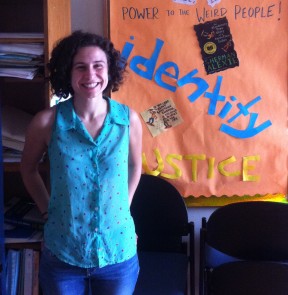 Chloe Zelkha is an alum of the 2013-2014 class of Jewish Organizing Fellows. Her JOIN placement found her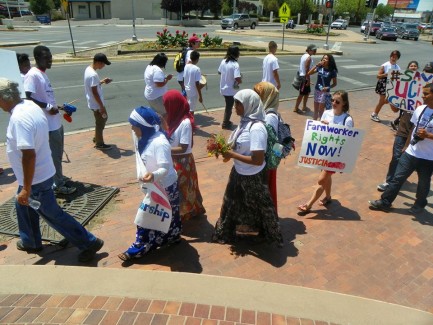
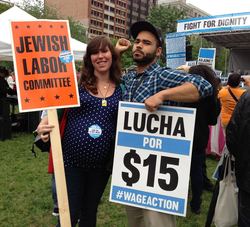 Union organizer and JOIN alum Corey Hope Leaffer wrote recently for the
  By Rabbi Sara Luria


