Power to Act for Change

JOIN alumni founded and led YMORE (Youth of Massachusetts Organizing for a Reformed Economy) is taking action! Teens from across Greater Boston will put elected leaders on the spot and demand that they stand for youth priorities: Youth Health, Youth Jobs, Environmental Justice, and Education! YMORE teens Frankie Bunny and LeKiara Gray talk about the issues on BNN News.

WHEN: Wednesday, May 16, 2012   –   5:30-7:30/8

5:30-6:15: Snacks & fun!
6:15-7:30: Action!
7:30-8:00: Pizza!

WHERE: The Cathedral Church Of Saint Paul
138 Tremont Street
Boston, MA
02111

For more information on the action, contact Maddie MacWilliams or call 617-596-3278

Posted in Our News | Tagged , , , | Comments Off on Power to Act for Change

Praying With My Feet

This post originally appeared on No Power in the ‘Verse.

I spent last Sunday and Monday in New York, at the HUC-JIR campus, attending the Jewish Organizing Institute and Network for Justice (JOIN for Justice) first National Summit, the organization’s first. I heard about it through Jews United for Justice, one of my favorite D.C. organizations. As a rabbi, I want to do organizing, so it was a good opportunity to network with other Jews doing social justice work. Indeed, those two days I walked around thinking, “Yes. These are my people.”

Simply put, the conference was awesome, for little and big reasons. I am dork, so I really liked that everything ran on time and stuck to the schedule. (Not everyone showed up on time to sessions (myself included on one occasion!) but that’s a different kettle of fish.) Every session I attended had a written agenda of what was to be covered, and in good organizing fashion, the agenda was reviewed and affirmed before each session. What can I say? I like knowing that presenters know what they’re doing.

The conference also got me super excited about moving to Boston. Bostonophiles had told me what a great city it is for social justice, but seeing is believing. I heard about so much good work going on and/or based there (where JOIN itself is located!), through Moishe Kavod House, Jewish Association for Law & Social Action, Massachusetts Senior Action Council, Boston Workman’s Circle, Keshet, Jewish Community Relations Council of Greater Boston, and more. I’m thrilled about the potential opportunities I’m going to have in rabbinical school.

And I heard some downright inspiring speakers: In the opening assembly, Simon Greer of Nathan Cummings talked about the Jewish legacy and future of social justice: “At the March on Washington, Jews blended in; at Occupy Wall Street, Jews stood out.” Ai-jen Poo of the National Domestic Workers Alliance spoke about community/labor coalition building: “All progressive movements, worker-related or not, bank on the utilization of the labor movement. We have to lift it up.” Marshall Ganz of the Kennedy School highlighted the necessity of a moral aspect to social justice work: “One cannot long last as a light to the world and a darkness at home.” Gordon Whitman of PICO emphasized the importance ofreligious Judaism: “We can’t have just a secular Jewish social justice movement.” Nancy Kaufmanof the National Council of Jewish Women: “Social justice comes from Jewish values — but has universal goals.”

One of my favorite sessions was “Mindfulness and Organizing Work,” led by Rabbis David Adelson and Lisa Goldstein. I really identified with Rabbi Goldstein’s section on text study as a mindfulness practice. As she noted, looking at a piece of text is the default Jewish spiritual practice in organizing — but doing so often puts participants into an intellectual space that can be anxiety-producing and can lead to tearing others down. “How can I demonstrate that I know more about Judaism than others? What if I don’t understand what someone else says? How can I show my independence of thought by disagreeing with the author?” Instead, Rabbi Goldstein suggested looking at text from mindful perspective: “What it wise, beautiful, true, or helpful about this text? What does this text teach me about myself and about where I am in the world?”

The Prophet Isaiah (I love the prophet art at HUC!); photo by Salem Pearce (via instagram)

Personally (as opposed to professionally), my favorite part of the conference was seeing my old friend David Segal (now Rabbi David Segal). We hadn’t seen each other since high school, when I was his yearbook editor. We’d friended each other on Facebook within the past couple of years, so we had some idea of what the other was doing. But because of the time built into the schedule for relational meetings (thanks, JOIN!), we were able to make that deeper connection as adults and as organizers. I got to hear about his path to the rabbinate and to Aspen, and I got to tell him about my path to Judaism and to the rabbinate. When we parted, headed to different sessions, he told me a story that gave me chills.

A friend of his, also a convert and a rabbi, shared with him a midrash (or perhaps a midrash on amidrash?): Between creation and when the Israelites went out of Egypt, G-d is said to have visited and offered Torah to all of the nations of the earth, who ultimately rejected it; only the Israelite nation, at Mount Sinai, accepted it — becoming the “chosen” people. David’s friend noted that in each of the rejecting nations, though, a few people in the back of the crowd raised their hands and said, “Wait! I want it.” That is him, he said.

That is me, too.

Salem Pearce is a proud Texan (is there any other kind?) who now lives in Washington, D.C., working and volunteering in the nonprofit world. This Summer she will start at Hebrew College Rabbinical School – follow her reflections at salempearce.com

Posted in National Summit, Thinking Out Loud | Comments Off on Praying With My Feet

Visuals for Change

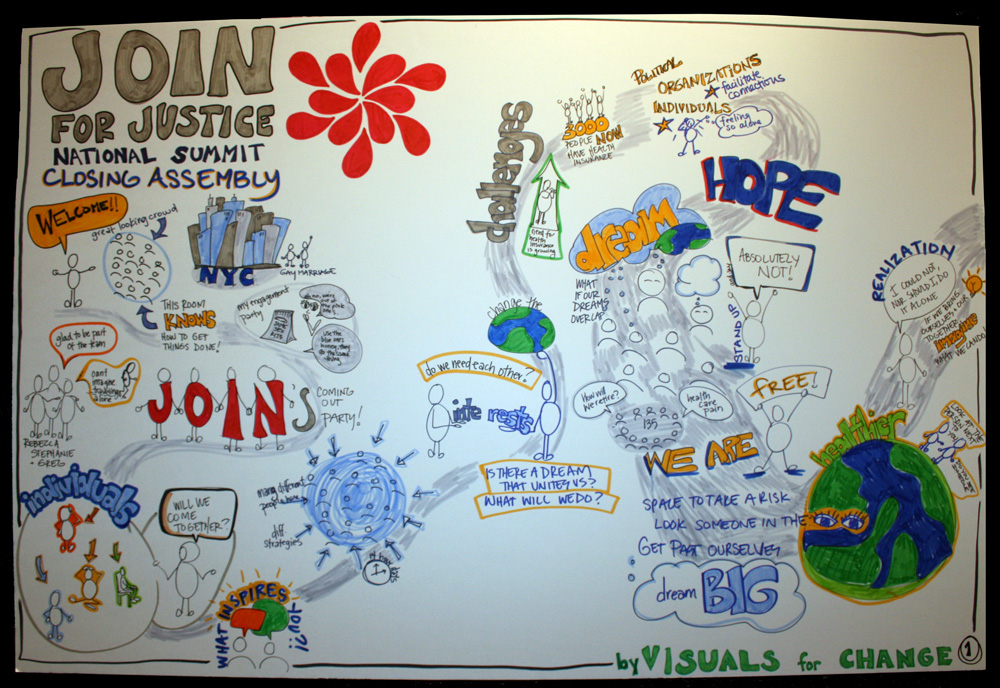
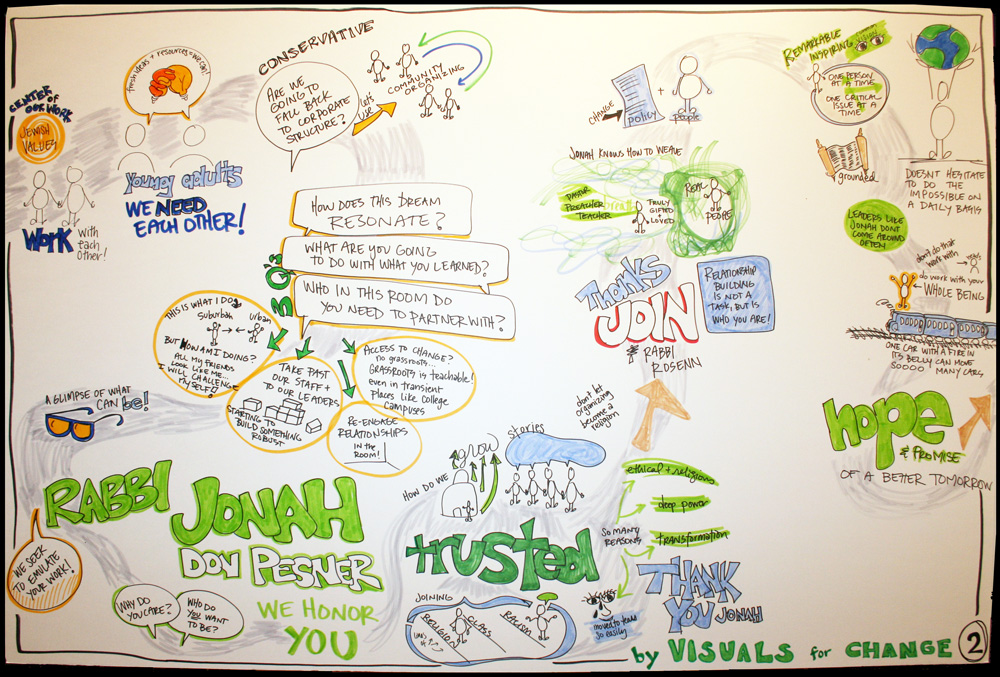
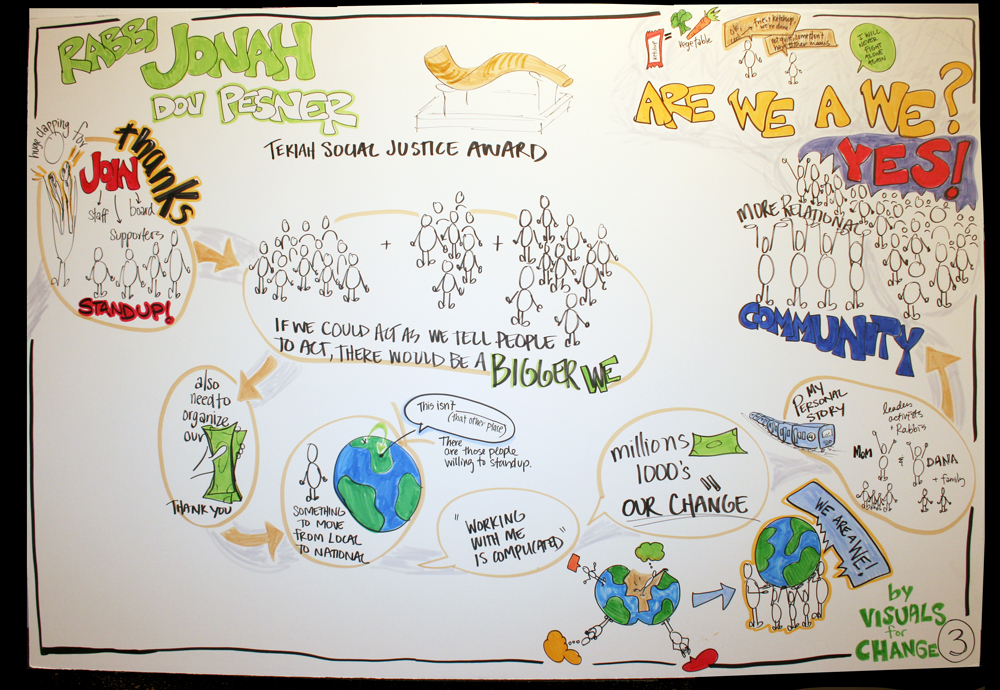
Are you a visual learner? The National Summit closing assembly featured graphic facilitation by artist Amanda Lyons, founder of Visuals for Change. As images and metaphors emerged during the assembly, Amanda created a work of art that represents the core of the program. Check out these photos of her graphic record to see a map of the narrative arc of our time together at the closing assembly:

Amanda created three large drawings. Want to see the drawings in person? We’ll announce when the drawings will be installed in our office!

Posted in National Summit, Our News | Tagged , , , | Comments Off on Visuals for Change

A Paper Cup

There was a paper cup sitting on the back of the water fountain. To most people, it was litter. To me, it was a sign that there were other Orthodox or traditionally observant Jews at the JOIN for Justice National Summit.


It was time to eat and I’d picked up one of the boxes containing lunch, all of which were sealed with a sticker identifying them as strictly kosher. But traditional halacha requires hand-washing with a blessing before saying ha-motzi, which I’d be doing before eating my sandwich. So I’d gone with a water bottle to the drinking fountain to wash my hands. And that’s where I saw the cup, left by someone else who followed the same rules.

When I think back on the conference, that moment is only one of many where I felt connected to other attendees. On the surface, these moments look very different from each other, and they felt different as well. Unlike the hand-washing situation, there were times when I felt frustrated, challenged, and overwhelmed… but I realized upon reflection that I needed to incorporate what had been said or what had happened into my own understanding.

Community isn’t about always feeling comfortable.

There was the session for clergy that I asked to attend so I could listen. The rabbis were talking about the challenge of trying to use organizing techniques to strengthen synagogues and other institutions, which tend to have entrenched cultures that resist change. And the main advice I heard was to be patient, to accept that it can take several years to be trusted as part of that culture, before which it can be difficult or impossible to make a significant difference.

Be patient?? I was frustrated. Organizing is a model that uses “the action” as one of its main tools! I had to spend time thinking over the difference between patience and apathy, and about the idea of doing work that you know will be less than ideal while you build up the people and systems that will make better work possible.

Then there was the session on meditation and using quiet practices to stay focused and centered enough to continue emotionally trying efforts. Another participant spoke up when there was room for questions. “Why are we talking so much?” she demanded. “If this is a session on silence, why are we talking? I’m tired of all this talking. I’m even tired of hearing myself talk!” (Similarly, in a discussion about engaging young adults, an acquaintance of mine asked “What songs should we sing?” in an attempt to remind us that there are many ways to feel connected and they don’t all involve talking.)

Stop changing the subject! I thought to myself. What’s being said is important! And it wasn’t until later on that I remembered all the times I’ve complained that there should be more singing in synagogue, that meetings shouldn’t only be about rushing through the agenda, that there needs to be room for people to sing and be quiet and laugh and connect.

The conference pushed me to consider what those connections should look like and encouraged me to use the relational meeting as the building block for creating that community. I haven’t stopped thinking about it since I got home.

Melissa Nunes-Harwitt is a Jewish educator and activist, and she is a graduate of Yale University and the Drisha Institute for Jewish Studies in Manhattan.

Posted in National Summit, Thinking Out Loud | Tagged , , , , , | Comments Off on A Paper Cup

Organizing, Fundraising, and JOIN’s National Summit

Presenter Marjorie Fine, Director of the Linchpin Campaign at the National Summit

Originally posted in Global Voices

What exactly is “organizing”? It’s a term people are using a lot more these days. From Wall Street to Tahrir Square, people are organizing for different kinds of change. But the idea of organizing from the ground up toward a common goal often makes people uncomfortable. Why is that?

As a fundraiser at AJWS, I can relate to this discomfort. Asking someone to make a financial gift is often met with apprehension, similar to the kind of apprehension someone feels when asked to sign a petition, call their member of Congress, or participate in a protest. It’s the “ask” that often puts people in a place where they are forced to think about how they tackle issues of injustice and whether they are willing to step up and take action. To get people to say “yes,” you need to build a relationship—which is really what organizing is all about.

Last week, I attended the Jewish Organizing Institute and Network (JOIN for Justice) National Summit at Hebrew Union College-Jewish Institute of Religion, along with a number of my AJWS colleagues and a group of incredible AJWS volunteers. Together, we learned more about organizing, what makes it Jewish, and how we are collectively harnessing our power to change the world on issues ranging from local labor unions to the U.S. Farm Bill. We were joined by some of the most influential leaders in organizing, including Heather Booth of the Midwest Academy and Ai-jen Poo, Director of the National Domestic Workers Alliance, as well as representatives from more than 20 organizations from across the country.

As a fundraiser, I was instantly drawn to the organizing models we discussed at the summit based on the premise of building relationships. This makes so much sense. Whether you are supporting a cause by donating money or by donating your time and skills through activism, you are becoming part of a larger movement. My views on philanthropy mirror my views on organizing. If you know there is a problem, you must work to fix it in whatever way you can.

The JOIN for Justice Summit was unique because it brought together people who are working on a wide range of issues. Facing so many problems head on can be overwhelming, but it is important to figure out what you are passionate about and support it in whichever way you can.

For 27 years, AJWS has been bringing people together to mobilize around issues of injustice affecting the world’s most marginalized populations. AJWS’s Reverse Hunger campaign is pushing Congress to uphold recent changes to the Farm Bill and its international food aid policies. The existing policies will provide more funding for local and regional procurement of food and will prevent the U.S. government from undermining local economies when we ship food aid overseas.

After many one-to-one relational meetings and petition signatures, a powerful coalition created the Jewish Platform for a Just Farm Bill. AJWS’s community leaders also began having meetings with members of Congress across the country (led by the same incredible volunteers who were at the JOIN Summit), to tell Congress that this change is crucial to the lives of millions of people in the developing world.

Bottom line: organizing really works! And it’s a tool that is becoming more and more useful for AJWS’s work in the developing world and in the U.S.

Interested in organizing your community around food justice? Learn more about the Reverse Hunger campaign to take action through a variety of organizing efforts.

Organizing can feel overwhelming, but I often remind myself of what Ruth Messinger reminds synagogue congregations: “It is not incumbent upon you to finish the task, but you are not free to desist from it.” (Mishna, Pirkei Avot 2:16)

Leah Kagan is a development officer at American Jewish World Service.

Posted in National Summit, Thinking Out Loud | Tagged , , | Comments Off on Organizing, Fundraising, and JOIN’s National Summit