


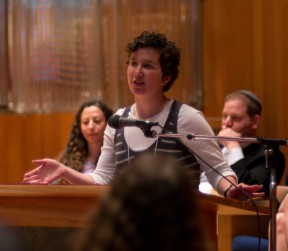
Rabbi Elan Babchuck, an alumnus of the Seminary Leadership Project, spoke at the American Jewish University Ziegler School of Rabbinic Studies ordination in Los Angeles last week. In his teaching, Rabbi Babchuck tells a powerful story drawing on his experience as a chaplain. This is a story about listening, and about learning how to connect Jewish texts and traditions to real life situations. “Our tradition will not matter,” he says, “if we do not know how to translate it into the real world.”
Endurance + Authority = Power
 In between Passover and the holiday of Shavuot which celebrates the Jewish people’s acceptance of the ten commandments, many Jews observe a seven-week period of counting called the Omer. The idea of counting each day represents spiritual preparation and anticipation for the giving of the Torah. Each day is connected to two mystical traits that we can cultivate, explore and connect to our daily lives and actions. Two that I find particularly fascinating are authority (in Hebrew, malchut) and endurance (in Hebrew- netzach). I have been thinking a great deal about how these traits connect to the folks I work with everyday.
I work for a wonderful, statewide, grassroots seniors organization. I therefore get to spend my time with wise, feisty seniors – folks who participated in the civil rights movement or simply decided they needed something to do in retirement that would allow them to continue working toward something and realized later in life that they could shout much louder in a crowd then they ever anticipated.
In the last week of April, we convened 250 seniors from all over Massachusetts to pack the gallery of the chamber of the House of Representatives in the state house as the reps were voting on the state budget. There, we initiated a mic check, discussing the necessity of the legislature to intervene in a decision made by the public transit authority to raise fares disproportionately for seniors, people with disabilities and youth – all vulnerable populations that live on fixed incomes. We chose this more confrontational tactic because all these groups have been consistently and clearly communicating their disapproval and concerns for months now, and they have fallen on deaf ears. So we needed to regroup and raise the stakes.
This was an amazing sight to see! Hundreds of elders taking over the floor from the suit-wearing, (in many cases) power hungry legislators. And though these seniors got thrown out pretty quickly, only to pour into the hall continuing to protest boisterously for about a half hour, it became clear that this move was one of fear from the state house higher-ups; that they understood the value in the message of these people who have lived long enough to know when they are being treated unjustly and are brave enough to recognize their own power, regardless of what society’s discriminatory messaging might be to and about the older generation.
I feel privileged to spend my days having my understanding of what it means to be old completely blown. At the same time, I am saddened by how little respect seniors are granted, how much they are made to feel like burdens in America. Old is perceived as a disease and so we pathologize elders rather than see their wisdom, their accomplishment, their resoluteness. But there seem to be many who honor their own endurance and are willing to voice the authority that it births. Insodoing, they are building up their collective power as a traditionally-marginalized group and ensuring that civic engagement and the democratic process are alive and well.
As we move from Passover to Shavuot, from a place of confinement to nationhood (at least in terms of the Jewish calendar), may we all grow to recognize the fallacy of the current hierarchies and nourish our own increasing authority as we grow older!
Rachie Lewis is a Jewish Organizing Fellow and works at the Massachusetts Senior Action Council. Originally from Elkins Park, PA, she graduated from Brandeis University in 2009. She is an alumna of AVODAH: The Jewish Service Corps and of Yeshivat Hadar.
Posted in Fellowship, Thinking Out Loud
Tagged Action, Boston, grassroots, power, Seniors, Shavuot
Comments Off on Endurance + Authority = Power
Ready for Leadership
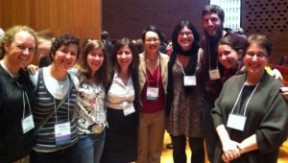
Photo courtesy of pursueaction.org
This post originally appeared at Pursue: Action for a Just World
Two weeks ago, The JOIN for Justice summit brought together an amazing group of folks on April 29th and 30th at Hebrew Union College in New York to sharpen their organizing skills, develop relationships with like-minded peers throughout the country, and articulate an growing vision of the movement of Jews committed to social change. The summit was a whirlwind of workshops, relational meetings, one-on-ones, and inspirational speeches. The sessions I attended, “Building Young Adult Jewish Power, Inside and Outside of Mainstream Jewish Institutions,” “Organizing and Mindfulness,” and “Community/Labor Coalitions and Domestic Workers Rights” re-charged me in my passion as an organizer and connected me to some amazing allies in discussions of building a stronger base of power of young Pursue-type folks to move the Jewish community in the directions we hope to see.
In the opening session, Nancy Kaufman, CEO of the National Council for Jewish Women, gave an anecdote on the long-term movement building work the Jewish community so that something like the JOIN for Justice summit was possible, saying that in 1990, it was a very lonely place in the Jewish community for those working for social justice. Sitting in a crowd of 230 self-identified Jewish organizers, 90% of us under the age of 35–and 100% standing in affirmation of the belief that the Jewish community should be organizing for justice in the world–it was moving for me to be reminded of how far the Jewish community has come in organizing for social justice. As an alum of AVODAH and AJWS, this gathering of organizers, activists, clergy, non-profit professionals, and allies is the Jewish community that I have come of age in. Many of us young summit participants have been trained for leadership through fellowships, seminars, service-learning programs, one-on-ones, and conferences since we were in high school. We are ready for leadership; we are ready to attempt to responsibly wield the power of American Jewry.
Looking around the room, I realized that this was not just a rag-tag group of Jews on the fringe fighting for a slice a pie, but the possibility of the future of the mainstream.
 Micah Weiss is the assistant director at Etgar 36, leading experiential education trips for Jewish teenagers that teach about history, politics, and activism, but will be moving back to New York in one month to attend Yeshivat Hadar. Last year, Micah was an AVODAH Corps member in Brooklyn where he worked as an anti-gun violence community organizer and inter-group facilitator at the Crown Heights Community Mediation Center. Micah graduated from Wesleyan University in 2010 with a degree in Religion and African American Studies.
Honoring Rabbi Jonah Pesner: An Activism Grown Out of Faith
 This post originally appeared on RJ.org
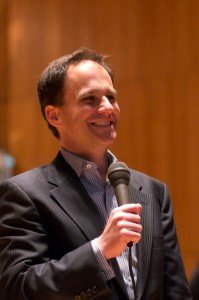
About 200 Jewish activists, rabbis, and communal leaders gathered in New York City for the Jewish Organizing Institute and Network for Justice’s (JOIN for Justice) recent National Summit. At the summit, JOIN for Justice honored the URJ’s Senior Vice President Rabbi Jonah Pesner with the Tekiah Social Justice Award.
Rabbi Pesner was honored for his work as a pioneer in the field of Jewish organizing and particularly for founding Just Congregations, the URJ’s groundbreaking community organizing effort. During his 20-year career, he has engaged thousands of synagogue congregants to join together in successful campaigns for health care access, affordable housing, public education, gay and lesbian rights, and rights for nursing care workers.
Speaking at the ceremony were Rabbi Rick Jacobs, president of the URJ; Rabbi David Saperstein, director of the Religious Action Center; and Rabbi Jennie Rosenn, Program Director, Jewish Life and Values, Nathan Cummings Foundation. Rabbi Rosenn’s remarks follow.
It feels most appropriate to be honoring Jonah in this sanctuary today. In 1996 I joined Jonah’s class for our final year of rabbinical school here at HUC. It just so happens that my most vivid memory of Jonah is of him sitting right there in the first row of that middle section. His hair down to his shoulders, he had a sort of, well, groovy air about him. Jonah had grown up in the bosom of the Reform movement, and was for all intents and purposes the quintessential poster child for the movement.
Though we respected each other from a distance, we really didn’t know each other well. Upon ordination, I went off to be a Hillel Rabbi at Columbia University, and Jonah became an Assistant Rabbi in Westport, Connecticut. And I think it is safe to say, we didn’t expect to see each other again outside of the occasional rabbinic conference.
Fast forward seven years. I had just come to the Nathan Cummings Foundation and as part of developing the field of Jewish social justice, I was thinking about how to grow congregation-based community Organizing beyond the handful of synagogues that did organizing back then. Everyone I talked with about it kept telling me about Temple Israel, this synagogue in Boston that really “got” organizing – and no one could tell me about Temple Israel without mentioning in the same breath a remarkable young rabbi named Jonah Pesner.
Around this same time, it became clear to me that the Reform Movement was key to bringing congregation-based community organizing to a larger scale. I began to have conversations with Rabbi Eric Yoffie, the then-president of the Reform Movement, and with Rabbi David Saperstein, Director of the Religious Action Center – conversations about what it would mean to introduce organizing to many more congregations across the country. I would say they were intrigued and skeptical in about equal measure.
It was not until Jonah came into the picture as a trusted Reform rabbi beloved by his community that Eric and David could fully get on board. And quite honestly, it was not until Jonah took a huge leap of faith leaving Temple Israel to start Just Congregations that the Nathan Cummings Foundation could fully get behind it. Over the last decade, first locally and then on the national stage, Jonah has played an absolutely pivotal role in the burgeoning of organizing in the Jewish community.
In a few minutes, David will speak about Jonah’s impact on the Reform Movement’s social justice work. But I just want to preface that by saying that beyond engaging scores of Reform synagogues across the country in organizing through Just Congregation, Jonah has been an inspiring teacher and mentor to seminarians, working with Jeannie Appleman and Meir Lakein, to train several hundred rabbinical students who in turn are engaging their communities in meaningful social change, joining together across lines of religion, race, and class, all while strengthening the fabric of their congregations. Just as Jonah has been central to the seminary training, so too JOIN for Justice has been blessed to have Jonah’s leadership at the helm.
Indeed Jonah’s leadership has been instrumental to making real the vision of a Jewish community that is developing leaders, building power, and bringing our world closer to wholeness. But what is it about Jonah that makes him such an exceptional leader and someone so many of us learn from? Is it his charisma? His passion? His incredible loyalty? Is it Jonah’s impressive ability to access to his inner preacher? Or how deeply he feels things? Is it his ability to be “relational” at a moment’s notice? Or who knows, maybe it’s the frequency with which he is moved to tears?
I am sure none of these things hurt!
But I actually believe that the power of Jonah’s leadership rests in no small part in the way in which his activism and Jewish life are authentically tied up with one another. This week’s Torah portion, Kedoshim, sometimes referred to as the holiness code, is unique in the way in which it indiscriminately mixes ritual mitzvot with social mitzvot.
In the same passage, we are told not to wear clothes made of two kinds of material and that we should leave the fallen fruit of our vineyard for the poor and the stranger. We are told the proper way to offer a sacrifice to God, what today has become prayer. And we are instructed that the wages of a laborer should not be held until the next morning.
Implicit in this quick succession of laws is the assertion that religious life and work of social justice are most powerful when woven together.
We are cautioned in this week’s parsha not to let organizing become a religion or let ritual distract us from acting justly.
And indeed Jonah’s life is a profound embodiment of the intertwining of the two. Every organizer’s fundamental tools are themselves and their stories. What is most powerful about Jonah’s stories are the way in which his commitment grows from a deep combination of the ethical and the religious. His is an activism growing out of faith and a faith that points towards action in the world.
To know Jonah is to know what it means to lead from a place of deep power that emerges from this union. It is why we honor Jonah this afternoon for his tremendous leadership and it is why we are inspired by him to look inside ourselves to find that place of meeting – that place where our spiritual lives meet our lives as activists. For it is in this place that transformation of ourselves, our communities, and our world is truly possible.
Thank you Jonah for giving us this opportunity to celebrate and honor you, our colleague, our teacher, and my friend.
 Kate Bigam is the URJ’s Social Media and Community Manager. Prior to this, she served as a Congregational Representative for the URJ’s East District and at the Religious Action Center as Press Secretary and as a 2007-2008 Eisendrath Legislative Assistant. She is a native of Cuyahoga Falls, Ohio, and currently resides in Portsmouth, N.H.
Posted in National Summit
Tagged Nathan Cummings Foundation, Rabbi Jonah Pesner, Tekiah Social Justice Award
Comments Off on Honoring Rabbi Jonah Pesner: An Activism Grown Out of Faith
Ready, Action, Celebrate
 Last week was jam-packed and inspired.
When I became a Jeremiah Fellow with Bend The Arc: A Jewish Partnership for Justice in 2011, I didn’t know just how much of a transformative experience it would be. As we come to the end of our cohort term, I reflect.
I am thankful for the many opportunities I have had because of being actively involved with Bend The Arc. Being able to say yes to invitations to engage volunteers, celebrated lay leaders, the White House and prominent civil rights activists since the fall of 2011 has been powerful. Being encouraged to head to New York for a community engagement training in its inaugural season was, naturally, a no brainer. I’ve come to know that when Bend the Arc calls, it’s time to say yes, take action and dive in.
Participating in the JOIN for Justice National Summit has made a lot of lightbulbs light in my head.
Ping! Pow!
…The thoughts began to flash when I landed in NY and teamed up with some of the fellows in my cohort and our fabulous team of mentors as part of the Jewish Social Justice Round Table’s Civic Engagement Campaign track. Dialoguing and learning best practices from other Jewish social action organizations, groups and volunteers in this intensive 3-day setting was invaluable and gave me an awareness of Jewish social action that made me even more dedicated to activism and community organizing. There was a lot to gain from convening in a mindshare with individuals representing California’s Bay Area, Detroit, Minnesota, New York, Los Angeles, Maryland, Chicago and Florida.
What is the Jewish Social Justice Roundtable (JSJRT)?
“The Jewish Social Justice Roundtable is a cooperative partnership among Jewish organizations working to elevate social justice to the center of Jewish life. Our members are committed to collaborating on progressive issues and creating explicity Jewish structures to address them. Although member organizations do not always work on the same issues or campaigns, they do share the goal of changing the underlying systems causing injustice in today’s society – whether on the local, state, national or international level – through direct service, capacity-building, advocacy and organizing.
In 2011, we began a national Civic Engagement Campaign, guided by Jewish values. Led by nine anchor organizations across the country, we are holding candidate forums, building capacity, and forming alliances to increase civic participation in the Jewish community.”
Take Aways
As we individually and collectively take the insightful training we received in New York back to our communities to implement strategic campaigns, I keep the following in my sinews:
1) Every win should be celebrated on the road to justice. Often times we forget that when the muck overshadows the good. It’s time to remember to celebrate because it’s time for winning. Small, big – celebrate.
2) Jews are on the ground for GBLT rights in states I’d never imagined. I am part of Jewish inclusion teams and have spoken on panels this past year for Jewish diversity and inclusion in Los Angeles and Maryland. To hear that people are on the ground engaging their communities to act for marriage equality in states like Minnesota empowers me. JOIN expanded my scope of hope.
3) Action vs. Activity. I hadn’t really grok’d the difference between the two terms until I sat in a session the first day of our convening. As 2012’s election month fast approaches, all of us from each of the eight organizations present at this year’s Civic Engagement Campaign training will be implementing activities. But, more than just launching a series of activities, we dissected the true meaning of making things happen; that is, engaging in strategic actions around key issues. This allows power and relationships to be built for the future in our respective communities and organizations. Really understanding the difference between action and activity is power.
I would have loved to been able to attend some of the other plenaries in order to network and learn with other members of the training. Perhaps at future summits, there will be a way to work this into the track, though I thought being able to attend a few larger group sessions with the entire summit participant roster was thoughtful.
All in all, I’m super excited and super charged post-JOIN; and really, it is just the beginning! I feel a subtle shift occurred, perhaps on a cellular level, for me at the training. Super cool.
Now, I am looking forward to celebrating some wins in 2012 with my fellow Jewish-based community organizers!
JOIN for Justice National Summit was a blast. I’d recommend it to anyone serious about diving into efficient and meaningful community organizing development, especially if you are privy to or involved with any of the Jewish Social Justice Round Table’s organizations*.
*To read about the organizations in the Round Table, please click here to view the list at the National Council of Jewish Women’s website. (Note: Progressive Jewish Alliance + Jewish Funds for Justice is now Bend the Arc.)
Tera Greene is an Artivist/Writer/Social Entrepreneur and award-winning DJ. She has blogged with the Jewish Journal Online’s “Oy Gay” blog since 2010. Follow her on twitter @djnovajade.
Posted in National Summit, Thinking Out Loud
Tagged Bend the Arc, GLBT, inspiration, Roundtable
Comments Off on Ready, Action, Celebrate



