
Nurturing a National Network of Leaders

Boston-based JOIN for Justice uses Jewish teachings to groom activists

By Sarah Smith
Special to the Advocate
*this article originally appeared in the Jewish Advocate.
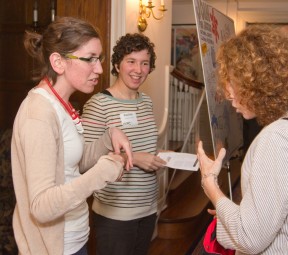
Julie Aronowitz and Rachie Lewis at Newton Reception

Julie Aronowitz had long struggled with where to focus her energies: within the Jewish community or with “people who really needed it.”

“JOIN was the first glimpse I got that it would be possible to do both,” Aronowitz said of the Jewish Organizing Institute and Network for Justice.

Through JOIN, she learned the skills to help Jews and non-Jews weather the 2008 financial storm, and later to mobilize fellow young Jews in community service.

Aronowitz is an alumna of the Boston-based JOIN’s Jewish Organizing Fellowship, which trains young Jewish adults in leadership and organizing skills. They go on to lead efforts ranging from immigration reform to promoting the interests of seniors.

Earlier this month, JOIN alumni and supporters met in a Newton living room to honor Rabbi Jonah Pesner for helping to shape the organization as its founding chair. Pesner, the new senior vice president of the Union for Reform Judaism, received JOIN’s Tekiah Social Justice award at the organization’s first national summit in April. The Newton reception was held to honor him in his hometown. Pesner, who founded Just Congregations, is a 20-year veteran of putting Jewish teaching into practice for social causes. It’s not just a matter of altruism, he told the Newton gathering, it’s key to the survival of Judaism.

“Judaism becomes irrelevant if it doesn’t become acted on in the world,” Pesner said. “We are Jews because we stand for something.”

Besides providing moral and ethical guidance, Jewish texts serve as a playbook of sorts for JOIN Fellows.

“[Exodus] isn’t about Moses speaking and everyone following,” said Karla Van Praag, JOIN executive director. “And that really is the way that organizing works – through building teams of people who are building followers.” The fellows often refer to the passage when Moses becomes overwhelmed leading alone and consults G-d about enlisting others.

Besides finding inspiration in Biblical figures, JOIN fellows have been motivated by the work of American Jewish activists in the labor and civil rights movement.

“What I got out of my time in the fellowship was to really ask what is Judaism’s vision for building a just society,” Aronowitz said. “Clearly there is not one vision.”

Recognizing that, she was able to be more attuned listening to the stories of young adults amid the 2008 financial crisis. She found that many wanted to help the community, but not through politics.

Aronowitz helped organize ReachOut!, a service and learning program sponsored by the Jewish Community Relations Council.

Putting to work skills she learned through JOIN, she used house meetings, personal relationships and participatory leadership to build the volunteer network.

The same relationship-based leadership module holds true in JOIN’s Seminary Leadership Project. Rabbi Greg Litcofsky participated in the seminary program in 2006, a year before he was ordained.

“It’s about people, not programs,” he said, explaining that some synagogues take a top-down approach rather than listening to their congregants. As an assistant rabbi at Temple Shir Tikva in Wayland, Litcofsky met one-on-one with members. When he learned that families with younger children felt slighted, he helped launch the Families Connection Committee.

Now a member of JOIN’s board, he will soon move on to be the rabbi at Temple Emanu-El in Livingston, N.J.

Each JOIN fellow completes an internship during their year.

Rachie Lewis, for example, works with a grassroots senior citizens’ organization, a position she found through JOIN. Lewis said the fellowship program has helped her learn to be pragmatic. “There’s a lot of discussion about the tension between the real and the ideal,” she said.

JOIN began as the Jewish Organizing Initiative in 1998 in Boston. Last year, JOI became JOIN for Justice. Last April, at national summit, it brought leaders from throughout the country for workshops and other learning sessions. Over the past 15 years, the initiative says nearly 150 young leaders have completed its programs.

“Boston is regarded as a national model,” Pesner said. “All across America they’re looking at community organizing … because of this work.”
Posted in Our News | Tagged , | Comments Off on Nurturing a National Network of Leaders

Breaking Records at Game Night

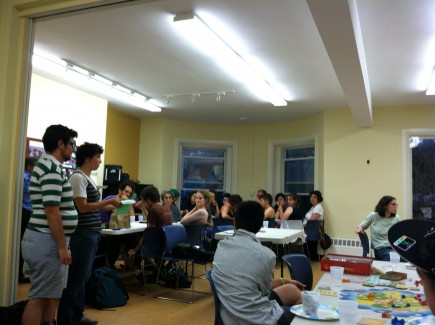
Jewish Organizing Fellows Rachie Lewis, Sam Dreyfus, and Eli Latto brought community members together at a Game Night Fundraiser last week, raising nearly $1,000 towards their fundraising goal. Contestants played games to vie for prizes supplied by other Fellows. Prizes included a cooking lesson, a massage, an outing to a baseball game, and more!

Posted in Fellowship, Our News | Comments Off on Breaking Records at Game Night

Fighting for Laid Off Workers

Jewish Organizing Fellow Phoebe Gardener and her placement organization Centro Comunitario de Trabajadores (Community Worker Center) in New Bedford, MA, made local news last week when they gathered to protest the firing of workers flagged as immigrants. The workers were given three days to get their papers in order, and were fired without severance pay. “Severance pay is one of the ways in which these workers can be given the respect and also given the financial help they need when they are suddenly laid off from work,” Phoebe said in an interview given to WPRI. Watch a video of the news report and read more press here.

Protest held for laid-off N.B. workers: wpri.com

Posted in Fellowship, Our News | Tagged , , | Comments Off on Fighting for Laid Off Workers

Why Interfaith Organizing Matters: Social Change Starts with Values

This article originally appeared in The Huffington Post.

Sometimes, as an activist, you look upon the world and think you will never be able to see the changes you seek in your own lifetime. It’s easy to despair, to succumb to the isolation and self-doubt that come from being a thoughtful person trying to change the status quo.

In those moments, I’ve learned to find renewal and hope not in myself, but in other organizers, in our shared values and experiences. Saul Alinsky wrote, “We must believe that it is the darkest before the dawn of a beautiful new world. We will see it when we believe it.” A shared belief in what is actually possible to achieve, despite what others may tell us: that is the organizer’s gift.

In one respect, this principle sounds self-evident. And yet, while our social movements are often full of talk about policy, tactics or messaging, values are regularly left to linger in the background. They become things that are left to theologians to debate, or we allow values to be a walled-off part of the political conversation.

As a result, conservatives are usually the ones who are able to claim the mantle of values and define what values-based politics in America should entail. Needless to say, their definitions of compassion, equality and freedom are different than those offered by progressives. The dominance of their worldview allows for a social order in which the middle class has grown ever more precarious and opportunities for the disenfranchised to better their lives have dwindled.

I think this, perhaps more than any other reason, is why interfaith organizing matters.

Every major faith — Christianity, Judaism, Islam, Buddhism, Hinduism — has a set of values grounded in the pursuit of justice and equity. This universalism is important. It creates the potential for far-reaching, welcoming movements that cut across boundaries of race, class, sect and nationality.

Working from a values-based framework means applying these principles of justice and equity not only when we think about society’s most downtrodden. It means integrating values into the most central questions of political life, including budgets and spending. For unless we articulate a clear vision of social justice before approaching policy, we end up only quibbling over the degree of social service cuts, not advancing a proactive, affirmative agenda.

Authentic Self-Interest and the Craft of Community Organizing

Yet celebrating universal values is not enough. A basic principle in organizing is authentic self-interest.

Community organizing is a craft with decades of history, going back through the innovations of pioneers such as Saul Alinsky and including the work that President Obama pursued at the start of his career. Community organizers have thought hard about how to mobilize people to create social change — in Alinsky’s words, how to bring the “power of organized people” to bear against “the power of organized money.” And community organizers have offered some profound insights about the role of values in politics.

When approaching potential allies, organizers ask, “Why do you care about this issue? Why does addressing it benefit you?” They are suspicious of those whose answers are too vague or impersonal — people who can talk about justice only in abstract terms.

To ask these questions is not to demand selfishness, but rather self-awareness. The truth that organizers have discovered through hard years of practice is that if you understand your own identity and your own faith — if you know where you come from and what truly matters to the communities closest to you — you can make a much bigger impact in the world. Moreover, particularity is not incompatible with universalism. Recognizing your own authentic self-interest allows you to appreciate and honor difference in a far more substantive manner.

A Reinvigorated Jewish Social Justice Agenda

My own grounding is in the Jewish community, and I have seen much there that gives hope for the revival of an interfaith social justice agenda.

In late April, I had the opportunity to attend the JOIN for Justice organizers’ summit in New York City. JOIN for Justice is a new group which formed from an important impulse. Starting in the 1990s, a collection of Jewish activists coming out of unions and other social movements noticed that when broad coalitions came together, there was not as strong of an organized Jewish presence as the tradition’s deep social justice values would warrant. Seeking to develop new generations of Jewish organizers as well as to expand the engagement of Jewish congregations in community organizing efforts (like the Industrial Areas Foundation (IAF), PICO, DART, and Gamaliel), Jewish organizations including JOI (the Jewish Organizing Initiative) and Bend the Arc (formerly Jewish Funds for Justice and Jewish Progressive Alliance) sought to create a training ground for Jewish leaders interested in community organizing.

JOIN for Justice’s inaugural summit was the culmination of two years of work to build a network that could have national reach. At the summit, participants attended workshops that ranged from traditional political panels such as “Voter Mobilization to Build Power,” to those that reflected a distinctly Jewish take on organizing, like, “Creative Ritual in Action” or “Raising Money with Chutzpah in Challenging Times.” Nearly 300 organizers gathered together, representing some 50 organizations from throughout the country. Sixty percent of them were under 35 years old.

JOIN for Justice is part of a new crop of reinvigorated Jewish social justice organizations. Groups like AVODAH: The Jewish Service Corps and Just Congregations are thinking about how they can have greater impact in the world and how they can be part of a national movement for racial, economic and social justice. Some older organizations like American Jewish World Service and the National Council of Jewish Women (NCJW) are reinventing themselves as well. NCJW chief Nancy Kaufman explains, “There is a wonderful confluence happening of older Jewish organizations like NCJW feeling re-energized by the number of newer Jewish social justice organizations, and I think the younger women are very excited about it also.” Around the country, she says, so many isolated groups “have been toiling in the lonely vineyards and very much want to be a part of something” more cohesive.

The JOIN for Justice summit was an important step in that direction. What was exciting to me was that the organization is one of the first contemporary manifestations of Jewish social justice activism on a national scale. Within the Jewish community, there is tremendous pride among an older generation about social justice titans like Rabbi Abraham Joshua Heschel, who served as an advisor to Martin Luther King Jr. However, a central challenge of the faith is not merely to honor the past, but to make our traditions relevant in a new time and a new context.

The young people I saw at JOIN for Justice are doing that by grounding themselves in authentic self-interest. They are taking inspiration from secular predecessors doing community organizing. Yet they view their work through a distinctly Jewish lens. They not only connect with a deep tradition of American Jewish organizing in the labor and Civil Rights movements; they see religious ritual and practice as a force essential for sustaining their work.

As much as the new generation of activists is focused outward, committed to making America live up to its promise of liberty and justice for all, they are attentive to the self, passionately articulating the religious values that inform their work. With this approach, they are providing a new definition of what it means to be Jewish in America.

On the broader political stage, I hope that their example will serve as a model of how progressives can organize with values — and that many more interfaith efforts in the same mold will follow. Because it is our authentic self-awareness that ultimately allows us to reach beyond ourselves and bring about lasting change that is rooted in integrity. We have to know who we are to believe in what we are doing.

Amy Dean is a fellow of The Century Foundation and principal of ABD Ventures, LLC, an organizational development consulting firm that works to develop new and innovative organizing strategies for social change organizations. Dean is co-author, with David Reynolds, of ‘A New New Deal: How Regional Activism Will Reshape the American Labor Movement.’ Dean has worked for nearly two decades at the cross section of labor and community based organizations linking policy and research with action and advocacy. You can follow Amy on twitter @amybdean, or she can be reached via www.amybdean.com.

Posted in National Summit, Thinking Out Loud | Tagged , , , | Comments Off on Why Interfaith Organizing Matters: Social Change Starts with Values

An Invitation to the Table

Witnessing the birth of something new can be confusing. I felt that way as a kid in the Northwest watching the 1999 WTO protests in Seattle, not knowing what to makes of the images on TV and I felt the same way watching the beginnings of the Occupy movement. I didn’t take it seriously. A bunch of kids who’d suddenly discovered that things weren’t as they should be. I wasn’t the only one who’d been marching in the streets for years who doubted it would become anything. But it did. And it’s transformed not only the political but in many ways the Jewish conversation in America.



Between those two moments, between childhood with the Battle in Seattle and today, Occupy, I went through a Jewishly apathetic childhood through 5 years of observance, a year in Israel to, again, disillusionment with a Judaism that seemed to like using phrases like “tikkun olam” more than it liked actually confronting any system, a Judaism I couldn’t talk about my politics on Israel with, or for that matter my politics on much of anything. If I was going to be a Jew and some sort of radical activisty person, those two identities would have to remain separate. But as Moses learned, its not easy to keep the sea in two and walk through on dry land. At some point it’s going to collapse. And if it doesn’t, it still takes one hell of a toll. At Occupy, I saw for the first time in my life, Jews saying they weren’t going to take it anymore. They weren’t going to be forced to choose between half identities or else live fragmented lives, always in some sort of closet. Here I saw Jews ready to insist to a traditionally secular left and to a complacent Jewish world that they had the right to live as whole people in both worlds.

On Kol Nidre at Occupy I felt that same way I’d felt before. That something new is happening here. That I like it. That I don’t know what to make of it. I could talk about the contents of the Summit itself. I could tell you about the workshops I attended; about how cool it was to share a drink with Amy Dean. I could tell about text studies and lunches. Or I could talk about what I think was accomplished, for many of the attendees, and for me.

It invited us to the table. It let us come together and start to build, not just a movement for greater political impact but a new Jewish home.

In the last workshop I had the opportunity to take part in, facilitated by Rabbi Margie Klein, I sat with other young adults and discussed where we saw a need to organize within the Jewish community itself. We talked about diversity of race, class and sexuality in our synagogues and our communities and how we can further agitate for further inclusion in those spaces. And we talked about pushing for the creation of a more open culture of dialogue, where ideological pluralism, particularly on the subject of Israel/Palestine is treated more as the Talmud treated pluralism, as productive discourse rather than as the McCarthys of history have treated it, as dangerous betrayal.

This Summit was a space to start those conversations, to talk about the struggles we’d fought in the Jewish community and how, maybe by fighting those together, we could create a more vigorous movement for broader change. Organizationally I’ve been part of that movement for the last year, as a member of Avodah: The Jewish Service Corps and, as a member of next year’s JOIN Fellowship I hope to continue whatever role I may have in it. But more than that, the lesson I take from the JOIN Summit is that if we want to really push the balance of power, if we want to organize and agitate and dedicate ourselves to a more just world, we have to stand on our own feet and stop apologizing for our values.

I’m not sure what to make of this “Jewish social justice” thing that I’m supposed to be a part of it, whether it’s just the continuation, transformation, judaization of some longer political tradition or whether it really is something new, being born and waiting for a name. And maybe I’m still hesitant. Maybe I still don’t know what to make of it. But I look forward to finding out.

Jeremy Wood is a current member of Avodah: The Jewish Service Corps in Washington, DC and an excited incoming finalist with next year’s JOIN Organizing Fellowship. A native of and longtime activist in Vancouver, British Columbia, Jeremy is trying to figure out how to make change in the strange worlds of America and American Judaism.

Posted in National Summit | Tagged , , , | Comments Off on An Invitation to the Table